
English Is Best Learned by Using It
Learning English is not just about studying grammar, memorising vocabulary, or completing exercises.
You learn to speak English by speaking English.

At English Caffe, we have built our learning environment around this simple principle. Whether you attend our classes in Noida, Greater Noida, or learn with us through our online English classes, you get regular opportunities to use English in meaningful, practical, and engaging situations.
Our classrooms are designed to make learners participate—not simply listen.
From one-to-one conversations and pair activities to debates, presentations, storytelling, public speaking and competitions, our learners are constantly encouraged to think in English, express their ideas, interact with others, and become more comfortable speaking in front of people.
What Learning Looks Like at English Caffe

There is no single activity that can make someone a confident English speaker.
Confidence develops gradually through repeated exposure to different communication situations.
That is why our practice includes a wide variety of activities designed to develop fluency, vocabulary, pronunciation, grammar, confidence, listening, spontaneity, presentation skills and overall communication ability.
Here are some of the ways our learners practise English.
1. One on One Conversations
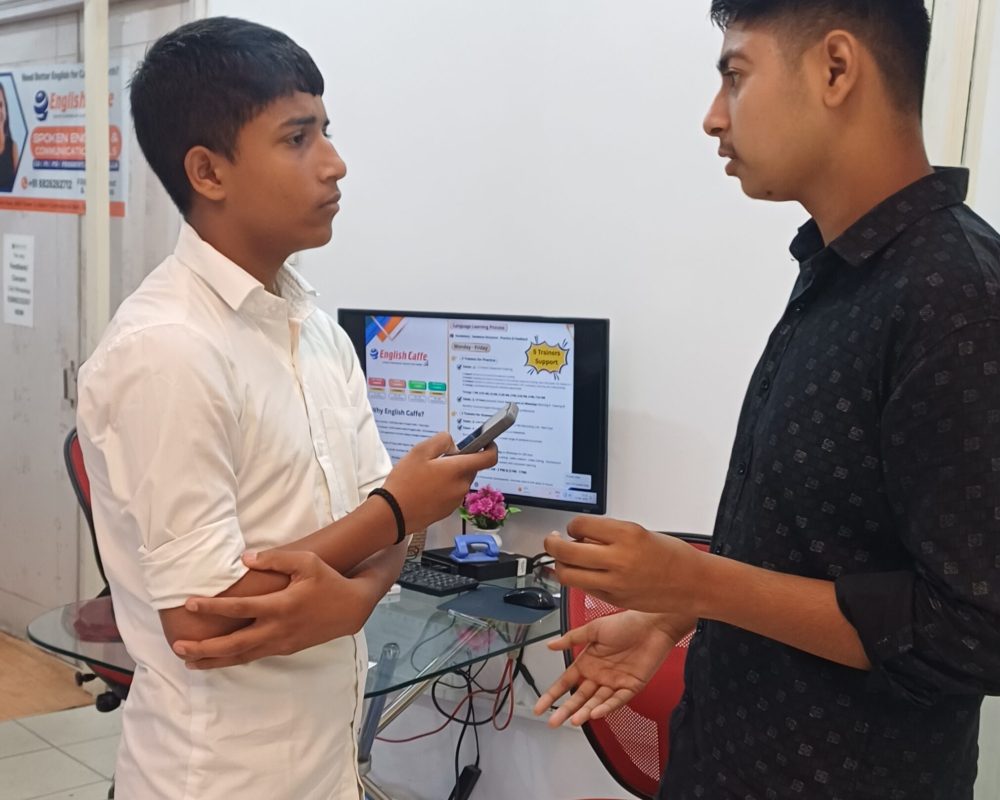
One-to-one conversations give learners the opportunity to speak directly with another person in English.
These conversations help learners practise everyday communication, answer questions, express opinions, describe experiences, and respond naturally without depending on memorised answers.
For learners who are hesitant to speak, 1:1 interaction can be an important first step towards becoming more comfortable with English.
2. Pair Speaking Activities

Speaking with a partner creates a more relaxed environment for practising English.
Learners may interview each other, discuss a topic, solve a problem, exchange opinions, complete information-gap activities, or work together on a communication task.
Pair activities increase the amount of time learners actually spend speaking and listening during a session.
3. Role-Plays
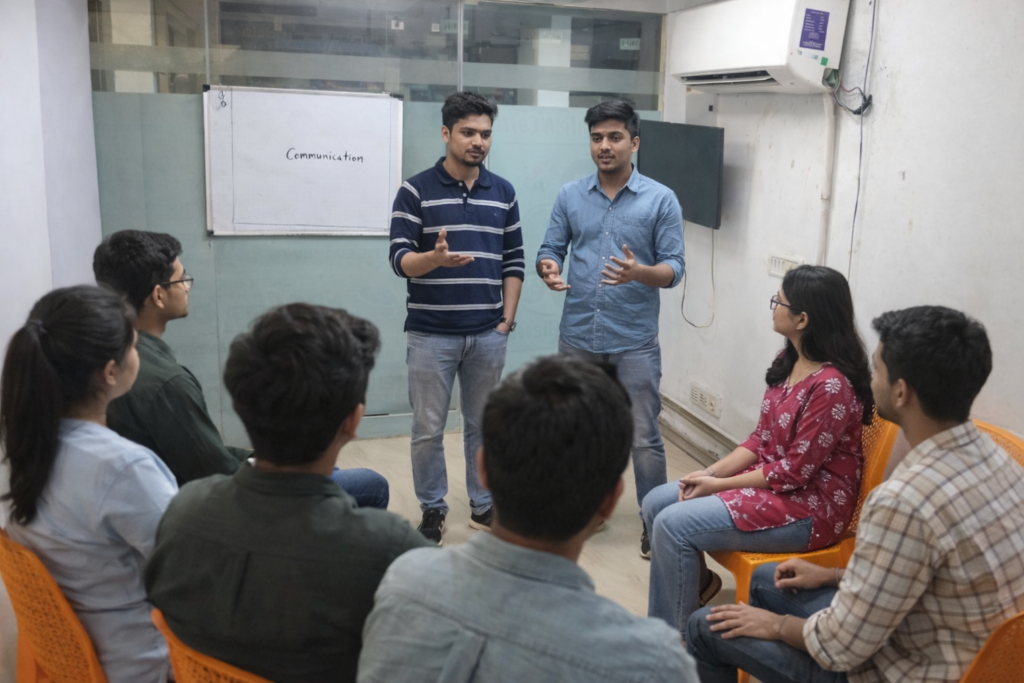
English becomes more useful when learners practise situations they are likely to encounter in real life.
Through role-plays, learners may practise situations such as:
- Meeting someone for the first time
- Making a phone call
- Speaking to a customer
- Asking for information
- Making a complaint
- Handling a workplace conversation
- Giving or receiving feedback
- Attending an interview
- Making a request
- Solving a problem
Role-plays allow learners to practise language while also developing confidence and appropriate communication behaviour.
4. Group Discussions & Debates
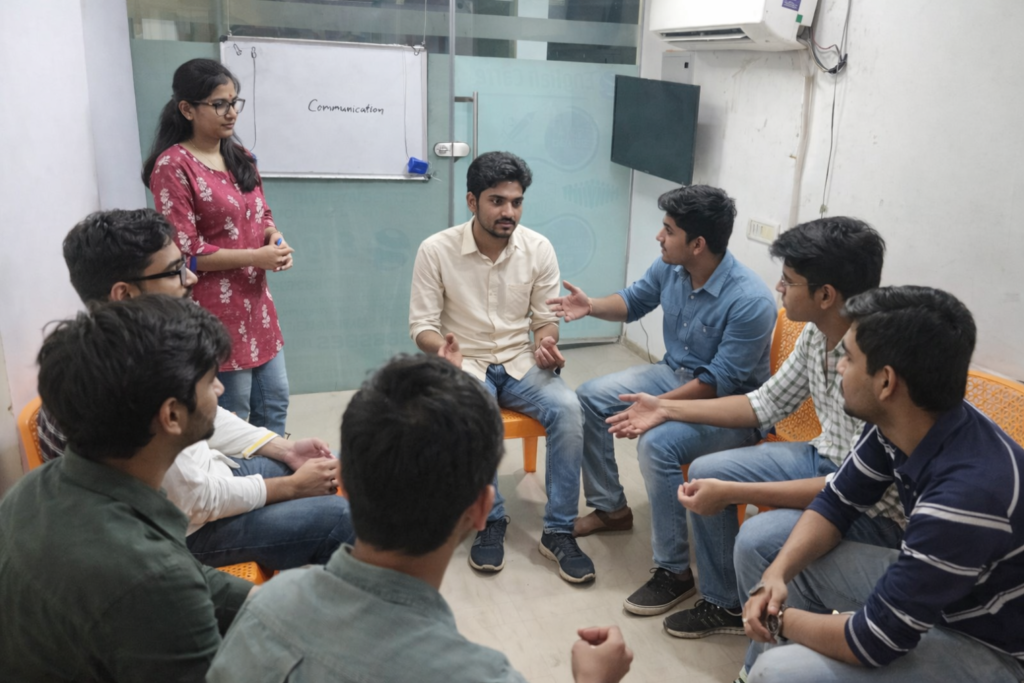
Speaking in a group requires more than knowing English.
Learners need to listen carefully, understand different viewpoints, organise their thoughts, respond to others, agree or disagree appropriately, and communicate their ideas clearly.
Our group discussions and debates provide opportunities to develop these skills.
Learners discuss familiar and thought-provoking topics, express their opinions, support their arguments, and learn how to participate constructively in conversations.
5. Outdoor Public Speaking

Communication confidence should not remain inside the classroom.
Our outdoor public-speaking activities give learners opportunities to step outside their usual comfort zone and communicate in a different environment.
Speaking before unfamiliar people or in a public setting can help learners work on voice, clarity, confidence, spontaneity and body language.
It also helps learners experience English as a real communication tool rather than simply a classroom subject.
6. Speaking Challenges

Improvement becomes easier when learners have clear opportunities to challenge themselves.
Speaking challenges encourage learners to speak for a particular amount of time, discuss an unfamiliar topic, use newly learned vocabulary, respond without preparation, or complete a specific communication task.
These challenges help learners gradually move from:
“I don’t know what to say.”
to:
“Let me try.”
And eventually:
“I can express my thoughts.”
7. Games & Fun Activities

Learning English does not have to be serious all the time.
Games and interactive activities create opportunities to practise vocabulary, sentence formation, listening, pronunciation, quick thinking and spontaneous speaking in an enjoyable environment.
Activities may include vocabulary games, word challenges, guessing games, communication games, team activities and other interactive exercises.
The objective is simple:
More participation. More practice. More English.
8. Prepared Speeches

Prepared speeches help learners develop the ability to organise their thoughts and communicate an idea clearly.
Learners select or receive a topic, prepare their ideas, structure their speech and present it before others.
Through repeated practice, they learn how to organise an introduction, develop their main points, give examples, conclude effectively and speak with greater confidence.
9. Storytelling

Storytelling is a powerful way to practise English because it combines vocabulary, grammar, imagination, sequencing and expression.
Learners may narrate personal experiences, retell stories, create fictional situations, describe pictures, or develop stories from prompts.
Storytelling helps learners move beyond individual sentences and develop the ability to connect ideas into a meaningful conversation.
10. Delivering Presentations

Presentations are an important communication skill in both academic and professional environments.
At English Caffe, learners get opportunities to prepare and deliver presentations on a variety of topics.
They practise:
- Structuring information
- Introducing a topic
- Explaining ideas
- Using examples
- Speaking clearly
- Maintaining audience engagement
- Using appropriate body language
- Answering questions
- Concluding effectively
These skills can be particularly valuable for students and working professionals.
11. Extempore Speaking

In real conversations, we rarely have the luxury of preparing every sentence in advance.
Extempore speaking activities help learners practise responding to topics with little or no preparation.
A learner may receive a topic and have only a short time to organise their thoughts before speaking.
This encourages quick thinking in English, improves spontaneity and helps reduce dependence on mentally translating every sentence.
12. Participating in Competitions
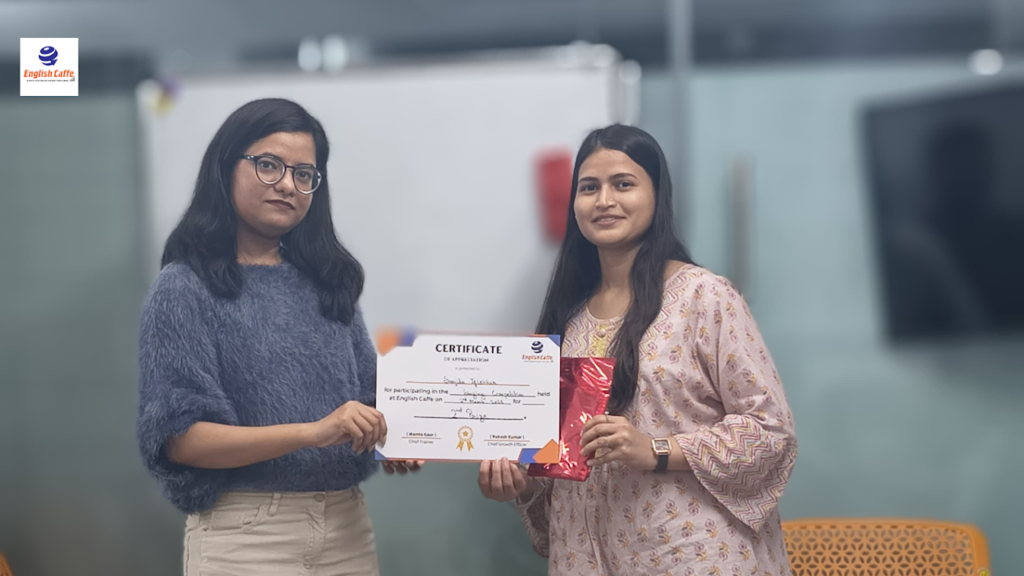
Competition can create an exciting reason to practise.
Throughout the learning journey, learners may participate in different communication-based competitions such as speaking challenges, debates, presentations, storytelling, vocabulary activities and other events.
Competitions give learners goals to work towards while providing opportunities to demonstrate what they have learned.
They also encourage preparation, participation, teamwork and healthy confidence.
Soft Skills Workshops

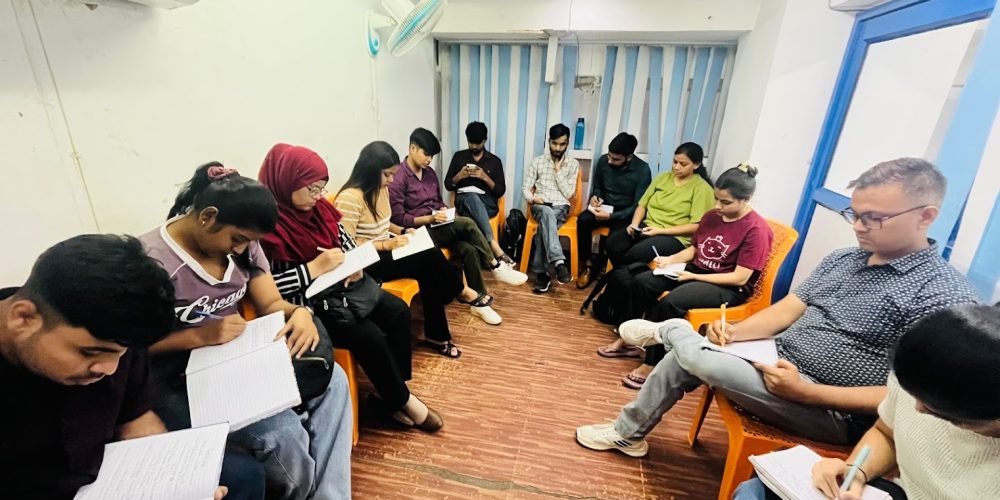
English communication is only one part of professional communication.
That is why English Caffe also conducts soft skills workshops designed to develop broader interpersonal and workplace abilities.
Depending on the program, workshops may cover areas such as:
- Communication skills
- Presentation skills
- Public speaking
- Interview skills
- Body language
- Confidence building
- Team communication
- Professional etiquette
- Listening skills
- Leadership communication
- Time management
- Workplace behaviour
- Problem-solving
- Personality development
These sessions help learners understand that effective communication is not only about using correct English. It is also about how you listen, respond, present yourself and interact with others.
From Classroom Practice to Real-World Communication
One of the biggest differences between knowing English and communicating effectively in English is experience.
You may know the correct tense but still hesitate when answering a question.
You may know hundreds of words but struggle to explain an idea.
You may understand English perfectly but become nervous when speaking before a group.
Practice helps bridge this gap.
At English Caffe, learners experience English in different forms:
Speak → Listen → Think → Respond → Present → Participate → Receive Feedback → Improve
With repeated exposure, communication becomes increasingly familiar.
Building the Confidence to Speak
We do not expect learners to become confident speakers in a single class.
Confidence is built gradually.
A learner might begin with a simple one-to-one conversation.
Then participate in a pair activity.
Then speak during a group discussion.
Then deliver a prepared speech.
Then attempt an extempore topic.
Then participate in a debate.
Then speak before an audience.
Each experience adds another layer of communication practice.
The objective is not to eliminate every mistake.
It is to help learners become comfortable communicating despite making mistakes, while continuously improving their accuracy and effectiveness.
A Learning Environment Where Participation Matters
Our trainers play an important role in creating an environment where learners feel comfortable participating.
Learners are encouraged to ask questions, attempt answers, share opinions, make mistakes and try again.
Rather than waiting for the “perfect sentence” before speaking, learners learn to communicate their ideas and gradually improve their accuracy.
This is particularly important for learners who have spent years studying English but have had limited opportunities to actually speak it.
Learning English in Noida, Greater Noida & Online
English Caffe brings this practice-driven approach to learners through our learning centres in Noida Sector 18 and Greater Noida, as well as through online learning.
At Our Noida Centre
Learners can participate in face-to-face speaking activities, group discussions, role-plays, presentations, public-speaking exercises and other classroom activities.
At Our Greater Noida Centre
Learners get access to the same practice-oriented approach in a classroom environment designed for interaction and communication.
Through Online Classes
Learners who cannot attend a physical centre can participate in online sessions and continue developing their communication skills from wherever they are.
While the mode of learning may be different, the objective remains the same:
Give learners meaningful opportunities to use English.
Learning English Should Feel Like Communication
English is not something that should only appear in a textbook.
It should be part of conversations, discussions, presentations, questions, stories, games, challenges and everyday interactions.
That is why we encourage learners to use English in as many different ways as possible.
Because the more situations you experience in English, the more prepared you become to communicate when it really matters.
What Learners Develop Through Practice
Our activities are designed to help learners gradually develop a range of communication skills, including:
Fluency
Expressing ideas with fewer unnecessary pauses and interruptions.
Confidence
Becoming more comfortable speaking before individuals and groups.
Spontaneity
Responding to questions and situations without preparing every sentence.
Vocabulary
Responding to questions and situations without preparing every sentence.
Grammar
Applying grammatical structures more accurately in communication.
Pronunciation
Working towards clearer and more understandable speech.
Listening
Understanding what others say and responding appropriately.
Presentation Skills
Organising and communicating information effectively.
Public Speaking
Speaking clearly and confidently before an audience.
Interpersonal Skills
Listening, responding, collaborating and interacting appropriately.
More Than English Classes
At English Caffe, we don’t want learners to leave with only a notebook full of grammar rules and vocabulary.
We want them to leave with experiences of using English.
They should have spoken to different people, participated in discussions, attempted presentations, told stories, handled role-plays, taken on speaking challenges, expressed opinions, competed, made mistakes, received feedback and tried again.
That experience is an important part of becoming a confident communicator.
The English Caffe Approach
Our approach can be summed up in one simple idea:
Don’t just study English. Use English.
Talk. Listen. Think. Participate. Present. Perform. Practise.
The more actively you use English, the more natural communication can become.
Whether you join us at English Caffe Noida, English Caffe Greater Noida, or through our online classes, we aim to make English a language you actively use—not simply a subject you study.
Ready to Use Your English?
If you understand English but hesitate to speak, or if you want to become more confident in conversations, presentations, interviews and professional situations, the best place to start is with practice.
Come, speak, participate and experience English at English Caffe.
English Caffe
Elevate Your English. Elevate Your Career.
Noida | Greater Noida | Online